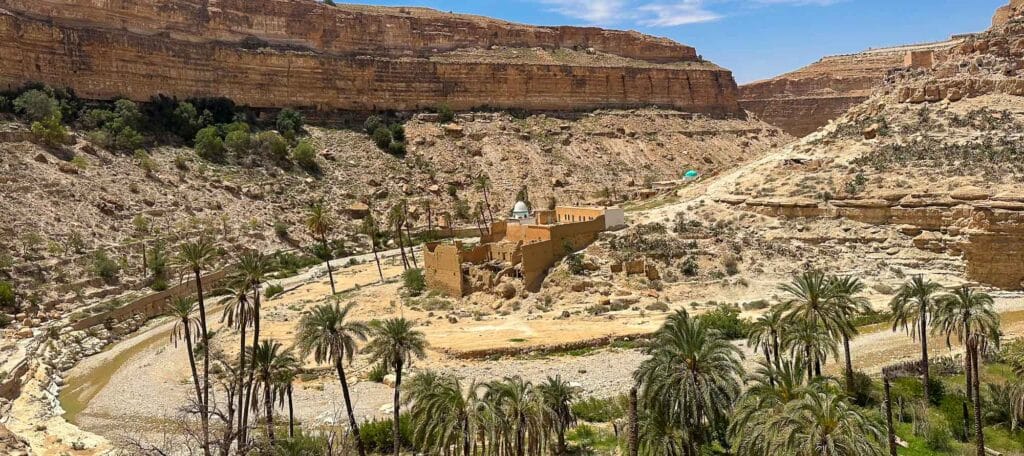
There are places where the desert is not an absence, but a presence. Touggourt is one of them. Here, the Sahara does not arrive as a rupture; it gathers itself slowly, breathing through water, palm groves, roads, cities, and faces. For producers, directors, and cinematographers, the Wilaya of Touggourt offers something increasingly rare: the ability to film the Sahara without losing narrative, logistical, or creative control.
Situated on the northern edge of the Algerian Sahara, this oasis-based region is neither a frozen backdrop nor an exotic postcard. It is a living system — human, economic, and operational — shaped by centuries of movement, belief, agriculture, and adaptation. Touggourt is not simply a destination. It is an intelligent base from which the desert can be explored, filmed, and understood.
A quick note on terminology: what is a Wilaya?
For readers unfamiliar with Algeria’s administrative structure, a Wilaya is the country’s primary territorial division — a level of authority situated between the national government and individual municipalities.
In practical international terms, a Wilaya can be understood as the equivalent of a province, a state, a federal state, a department, or a prefecture.
From a film‑production perspective, this level is decisive. The Wilaya is typically where regional permissions are coordinated, where local authorities interface with productions, and where logistical decisions are anchored. Understanding this scale allows producers to immediately grasp who decides what, and how a production truly operates on the ground in Algeria, often in close collaboration with a local film fixer and production coordination in Algeria.
Entering the Sahara Without Being Consumed by It
For international productions, filming in the Algerian desert is both promise and peril. Its immensity fascinates; its isolation intimidates. Touggourt functions as a threshold — a point of entry where the desert becomes accessible without becoming overwhelming.
Arriving by road, rail, or air, crews encounter a functioning city: services, infrastructure, skilled coordination, and a population accustomed to circulation and exchange. From this anchor point, the territory unfolds gradually.
In production terms, the desert is never a single location. It is a constellation of distances, textures, and temporal rhythms. Touggourt allows a shoot to be designed in concentric circles — urban centre, oasis, dunes, open desert — while preserving continuity and control.
For producers, this translates into reduced uncertainty and contained costs. For directors, it enables narratives that evolve spatially without logistical rupture. For cinematographers, it means engaging with desert light without sacrificing precision or repeatability.
Touggourt: A Modern Saharan City
Touggourt is an oasis city, but it is also unmistakably contemporary. Wide avenues, active markets, administrative buildings, and residential districts position it as a regional hub within the Oued Righ valley.
Visually, the city offers constant contrast. Within minutes, one can transition from modern streets to older neighbourhoods, from dense urban activity to palm‑lined calm. On screen, this coexistence is invaluable. It allows filmmakers to depict a Sahara that is present‑day, inhabited, and evolving — not frozen in time.
From a production standpoint, Touggourt naturally becomes the basecamp. Accommodation, catering, healthcare, telecommunications, transport, data management, and decision‑making converge here, creating a stable operational core for desert shoots.
Temacine: Proximity to the Sacred and the Intimate
Roughly ten kilometres south of Touggourt, Temacine reveals a different tempo. The pace slows. Space turns inward. Architecture, palm groves, and spiritual life shape an atmosphere of restraint and depth.
Cinematically, Temacine is a territory of intimacy. Images are less declarative, but more resonant. Walls carry time. Faces suggest lineage and transmission. Silence becomes a material.
Filming here requires preparation, dialogue, and respect. Permissions are not merely administrative; they are relational. When approached correctly, Temacine responds with a level of authenticity rarely accessible to the camera.
For documentary storytelling, the area offers profound narrative density. For fiction, it provides settings imbued with meaning. For cinematographers, it delivers softened, filtered light — shaped by palms, dust, and earth‑toned surfaces.
The Oued Righ Palm Groves: A Cultivated Desert
The Sahara surrounding Touggourt is not empty. It is irrigated, cultivated, and inhabited. The palm groves of the Oued Righ form one of the region’s most striking landscapes — at once graphic and alive.
Aligned palms, irrigation channels, and repetitive agricultural gestures establish a visual grammar rooted in continuity and labour. These environments lend themselves naturally to documentary cinema and grounded narrative work.
From a production perspective, the palm groves offer stability. Activity follows known cycles, access routes are established, and daily rhythms are predictable — ideal conditions for long‑form shoots and observational filmmaking.
The Dunes: The Space of Pure Cinema
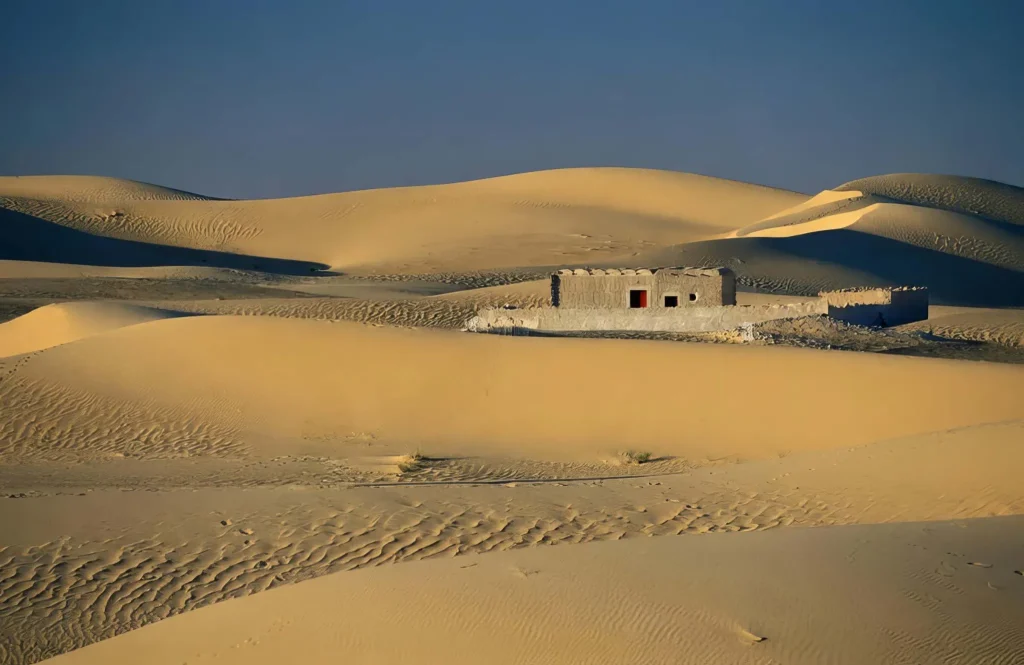
Beyond the city and the oasis, the landscape opens. The dunes surrounding Touggourt are not the most extreme in the Sahara — and this is precisely their strength for cinema.
Lines remain readable. Access is achievable. Distances are manageable. Light becomes extraordinary during low sun angles. For cinematographers, this is a demanding but generous environment, where scale and clarity coexist.
From a production standpoint, these dunes allow ambitious desert sequences without expedition‑level logistics. Crews can depart at dawn, shoot through optimal light, and return to base the same day — a rare operational advantage in desert filmmaking.
Ancient Districts and Ksour: Mineral Memory
Across the Wilaya of Touggourt, older districts and ksour persist — sometimes inhabited, sometimes slowly eroding.
On screen, these spaces carry immense visual weight. Textures, volumes, and narrow passages convey history without exposition. They are ideal for narratives concerned with memory, identity, and continuity.
Filming in these areas demands sensitivity and preparation, but the resulting images possess a density that cannot be fabricated elsewhere.
Cultural & Heritage Landmarks — A Lived‑In Sahara
The Wilaya of Touggourt belongs to a broader Saharan continuum shaped by oasis life, spiritual traditions, and centuries of circulation across desert routes.
Key elements of this cultural landscape include:
the Oued Righ oasis system, among the most extensive palm‑grove networks in south‑eastern Algeria;
traditional ksour and historic neighbourhoods, shaped by climate, water management, and community life;
spiritual and religious sites in Temacine, whose influence extends far beyond the region;
Saharan desert landscapes accessible directly from an urban base.
Together, these elements form a Sahara that is lived‑in rather than monumental — a territory that reveals itself through daily life as much as through vast horizons.
PRODUCTION FOCUS — Practical Filmmaking in Touggourt
Touggourt enables productions to operate efficiently within a Saharan context:
Access — proximity to an airport, national road networks, and rail connections;
Basecamp logic — hotels, services, and secure accommodation for crews;
Mobility — short travel times between city, oasis, and dunes;
Risk management — medical access, predictable weather patterns, controlled isolation.
This operational balance makes Touggourt particularly well suited to documentaries, series, feature films, and high‑end commercial work requiring desert environments without excessive exposure.
VISUAL CINEMA NOTES — Light, Lenses, and Time of Day
For cinematographers, Touggourt is an environment that rewards discipline.
Light — powerful yet readable. Early mornings and late afternoons are essential; mid-day demands intention and control — a rhythm closely tied to the best times to film in Algeria.
Atmosphere — fine dust in suspension softens contrast and adds depth, especially in backlight.
Focal lengths — wide lenses articulate scale in the dunes; longer lenses compress palm groves and urban textures.
Colour palette — earth tones, muted greens, pale skies, all highly responsive to subtle grading.
The region offers remarkable continuity of light, allowing visual coherence across extended shooting periods.
Hosting a Crew in the Sahara
Touggourt offers several hotels adapted to professional film crews. Comfort is functional rather than ostentatious — often exactly what desert productions require.
A balanced accommodation strategy — hotels for heads of department and leadership, alternative lodging for certain teams — ensures flexibility without compromising rest or morale.
Beyond accommodation, the city provides restaurants, services, and markets. In desert filmmaking, recovery and rhythm are as critical as time on set.
Filming Responsibly: Reputation as a Production Asset
Filming in the Algerian Sahara carries responsibility — not as a slogan, but as a professional standard. These are living territories, not empty stages, and the way a production behaves on the ground directly shapes its reputation, access, and long‑term viability.
Respectful engagement with local communities is both an ethical and strategic choice. Productions that listen, adapt, and collaborate experience smoother operations, stronger local support, and greater authenticity on screen. Employing local crews, fixers, drivers, and service providers whenever possible is part of that responsibility.
Equally important is how locations are entered and left. Footprints are not only physical. Discretion, time discipline, cultural awareness, and environmental care determine how a production is remembered once it moves on.
In regions like Touggourt, reputation travels faster than permits. Responsible productions build long‑term relationships, secure future access, and contribute to a sustainable filmmaking ecosystem — where trust becomes the most valuable production asset.
Film in Algeria: Presence with Precision
Film in Algeria approaches Touggourt not as a commodity to be sold, but as a territory to be understood and structured.
Through local knowledge, logistical coordination, and production-level awareness — supported by an experienced film fixer in Algeria – Film in Algeria supports filmmakers in working efficiently, respectfully, and creatively within the region — quietly, precisely, and without exaggeration.
Conclusion: A Habited Sahara
Touggourt and Temacine reveal a Sahara that is inhabited, structured, and alive — shaped by water, belief, labour, and movement.
For cinema, this is a territory of the future: a place where exploration does not undermine production, and where production does not erase exploration. A rare balance, deeply cinematic.
To film Touggourt is not simply to film the desert. It is to film the relationship between humanity and immensity.